Posts

Showing posts with the label Reading

Reading Notes: Pareekshit

Image
  Pareekshit Pareekshit is the King of Hastinapura. One day, he decides to go hunting where he stumbles upon the hut of a sage who has taken a vow of silence. When the sage doesn't speak to him, Pareekshit drops a dead snake on his shoulders! The sage's son decides to curse Pareekshit and claims that the snake Takshaka will kill him within a week. In order to avoid this, Pareekshit builds a palace at the top of a pillar that is surrounded by guards. What Pareekshit doesn't know is that Takshaka can turn into a human form! Pareekshit sends for a brahman priest who has an antidote for Takshaka's poison, but Takshaka assumed his human form and sent the priest away. Takshaka then took form as a worm and snuck into a fruit basket that was being brought to Pareekshit. Once he was alone with the king, he turned into his true form: a giant snake! He bites Pareekshit, causing him to die.  Pareekshit's son, Janamejaya, then becomes king. Janamejaya hates Takshaka and vows to ...

Reading Notes: Ravana Humbled

Image
  Ravana Ravana Humbled Ravana happens to disturb Mount Kailasa while Shiva, the God of Destruction, and Parvati, the Mother Goddess, are arguing. Shiva presses down harshly with his toe whenever he discovers Ravana and traps him beneath the mountain. Shiva is impressed by Ravana's courage, and gives him the sword Chandrahasa. Ravana travels to the city of Mahishamati where Kartaveerya Arjuna is king (note: not the character in The   Mahabharata  who is also called Arjuna). Arjuna is bathing in the Narmada river. Whenever he is provoked by his wives, he uses his arms to block the flow of the river.  Ravana, meanwhile, is worshiping a Shiva linga, but whenever Arjuna blocks the flow of the river, the flood of waters washes it away. Ravana, who is angered by this, challenges Arjuna to a fight, and Arjuna wins. Ravana's grandfather, Pulastya, begs Arjuna to set Ravana free. Arjuna decides to free him and pledges friendship with him. Ravana then travels to Kishkindha. Th...

Reading Notes: Kashyapa and Nagas

Image
  Nagas Kashyapa and Nagas N agas are supernatural serpents that are depicted as either complete serpents, complete humans with multiple snake hoods protruding from the back, or being half-snake and half-human. They are also known to live in an aquatic realm that is filled with treasures. It is also thought that anthills are portals to this world. Nagas are often seen as a symbol of rebirth, death, fertility, immortality, medicine, health and wealth due to their mystical powers. According to The Mahabharata , rishi Kashyap and Kadru are the parents of all nagas. Shesha was the eldest, and then came Vasuki, Manasa, and many more. Kashyapa had another wife, who was also Kadru’s sister, Vinata. She gave birth to Vishnu’s vahana, Garuda, an eagle-human hybrid and he became the arch-nemesis of the nagas since eagles consume snakes. In The Ramayana , Indrajit used the Nagapasha astra on Rama and Lakshmana, which hurled venomous snakes over them. The two fell unconscious and Garuda came t...

Reading Notes: Garu

Image
  Garuda Garuda is a divine being whose features are a mixture of an eagle and a human. Garuda is actually mentioned in The Ramayana, as he helps Rama and Lakshmana from the Nagaastra during the Ramayana War. He is also the brother of Aruna, who is known as the charioteer of the sun. Garuda's sworn enemy are the Nagas, who are also his half-brothers. Garuda freed his mother from slavery by stealing the pot of nectar from Indra. The Garuda Purana is believed to be a narration by Vishnu to Garuda who is also Vishnu's Vahana. This is particularly interesting to me, as my storybook is about vahanas! It is interesting that Garuda is a vahana since he has so many characteristics of a human. As Garuda is a Vishnu's vahana, he is mentioned in various Puranas and the epics. Bibliography:  “Who Is Garuda?: Amar Chitra Katha.” Amar Chitra Katha | , 3 Nov. 2020, www.amarchitrakatha.com/mythologies/who-is-garuda/.

Reading Notes: Kacha and Devayani

Image
  Kacha and Devayani Kacha went to be trained by the guru  Shukracharya in order to learn the Sanjivani Mantra, which would allow those to revive themselves from the dead. While there, he met Shukracharya's daughter Devayani. Devayani was determined to marry Kacha as soon as he finished his education. This made others jealous, as they desired Devayani. One evening, Kacha did not return home from watching the cattle graze. Devayani was distraught at his disappearance and begged her father to go with her to find him using his powers. He eventually found Kacha dead in the forest and realized the other students had killed him. He revived Kacha with his powers for his daughter. The other students, however, killed him again in the forest. Devayani's father once again revived him out of love for his daughter. In order to try and trick Shukracharya to not revive Kacha, the students killed Kacha again and then cremated him. They mixed his ashes with Shukracharya's wine so that whe...

Reading Notes: The Ramayana Comic Book Reading Diary B

Image
  Kumbhakarna: The Sleeping Giant Kumbhakarna is the brother of the evil Ravana, who was holding Sita captive. Kumbhakarna was so mighty that he was even able to defeat Indra in battle. Later on, Brahma awards the three brothers, Ravana, Kumbhakarna, and Vibhishana, wishes. Indra, who was still angry about losing and feared Kumbhakarna becoming stronger, wanted Kumbhakarna to make a foolish wish. Kumbhakarna does make a foolish wish, which causes him to go into a deep slumber. When Rama comes to reclaim Sita, he defeats Ravana. Angry, Ravana demands that his brother Kumbhakarna is woken from his slumber. Waking him up was very dangerous, as he was very hungry!  When Kumbhakarna awoke, he took out many soldiers in Rama's army. Fearing for the rest of his army, Rama goes and challenges Kumbhakarna himself. While he was a strong opponent, Rama was able to defeat Kumbhakarna. Bibliography: Kumbhakarna: The Sleeping Giant by Amar Chitra Katha

Reading Notes: The Ramayana Comic Book Reading Diary A

Image
  Sugriva Challenges Vali Comic One: Vali Vali is the mighty king of Kishkindha. While he was king, there was an evil rakshasa named Dundubhi that roamed across the earth. Dundubhi was very malicious and would go and terrify parts of the world, such as the Ocean. One day, he decided to go terrify Himavan, also known as the Himalayas. When Dundubhi approached Himavan, Himavan told him that Vali would be a mighty opponent for Dundubhi. Thus, Dundubhi turned into a water buffalo and traveled to Kishkinha to see this king for himself. Vali defeated Dundubhi easily and tossed his dead carcass on Rishyamuka mountain and for this he was cursed. If he ever stepped foot on that mountain, he would immediately die. When Dundubhi's son, Mayavi, heard of his father's death, he went to challenge Vali. Mayavi runs into a cave and Vali follows him while Sugriva, Vali's brother, remained outside. Days pass and then Sugriva heard a loud roar and blood flowing out of the cave. Sugriva feared ...

Reading Notes: The Mahabharata Part D

Image
  Arjuna at the War: Flickr Yudhishthira makes one final plea for peace and sends Krishna as an emissary. Dhritarashtra hears of this and wants to host a lavish reception; however, many of his advisors tell him that Krishna has come for peace, not for a party. His son, Duryodhana, also hears of this and plans to take Krishna captive. When he meets with Krishna, he refuses to give peace and ignores the please of his mother. Krishna then transforms into his divine form at the reception, thus Duryodhana cannot capture him. Before returning to the Pandavas, Krishna tells Karna of his true heritage and tries to get him to ditch Duryodhana. However, he promises to only attack Arjuna and not the other four brothers. Now, it is time for the war to begin. Draupadi's brother is made the commander for the Pandavas while Bhishma is made the commander for Duryodhana's troops. Before the war begins, Arjuna is horrified at the thought of fighting his old master, Drona, and members of his own ...

Reading Notes: The Mahabharata Part C

Image
  Duryodhana fighting Bhimsena: Flickr Dhritarashtra sends out spies to go watch the Pandavas; thus, he discovers the weapons that they have possessed. Duryodhana goes out and sets up a royal camp near where the Pandavas are living in order to try and humiliate them. In order to protect them, the gods send down a gandharva to provoke Duryodhana, which ends up with him being captured. The Pandavas discover this and free him, so ultimately, his plan to embarrass them backfired. The Pandavas return to the forest. One day, they are approached by a brahmin who begs for them to go capture a deer that has stolen what he needs to make a sacrificial fire. The Pandavas chase the deer, but to no end. They are all exhausted and look for water. One of the brothers finds a lake where a voice tells him to answer questions before drinking. Ignoring this, the brother takes a drink and dies. One by one this happens until Yudhishthira finds the lake. He answers the questions. We discover that this wa...

"Extra Credit" Reading Notes: The Mahabharata Part B

Image
  The Pandavas: Wikipedia Dhritarashtra discovers that the Pandavas are still alive; however, he does not hate them. His sons do hate them though. Bhishma and Vidura tell Dhritarashtra that he should try to make peace while Karna tells him that they are all traitors. In the end, he decides to make peace by giving them a piece of his lands. After given the lands, the Pandavas decide to build a great city: Indraprastha. One day, they are visited by a sage who warns them of potential conflicts due to sharing a wife. One conflict that does occur is Arjuna walks in on Yudhishthira and the wife making love and thus he is exiled for 12 years. During this 12 year exile, he marries a naga princess as well as the sister of Krishna. During this time, Yudhishthira is crowned to become king. Since he was to have a coronation, Duryodhana, one of Dhritarashtra's sons,  decided to go. Duryodhana, is deeply jealous of the kingdom. Shakuni, his maternal uncle, begs him not to mess with the...

Reading Notes: The Mahabharata Part A

Image
The Mahabharata: Wikimedia Commons Santanu was the ruler of an ancient kingdom. He came across a beautiful woman one day while hunting and decided he wanted to marry her. She agreed to marry him only if she could still have her freedom and he never questioned her. Eventually, the two had a baby that she drowned in the river. Santanu was shocked, but could not ask her any questions due to their agreement. From then on, every child they had she drowned in the river until they got to the eighth child. Santanu followed her to the river and begged her to stop. She agreed to spare the child, but stated that they had to part. He begged for her to tell him why. He discovers his wife was the deity of the river: Ganga. She had taken human form in order to give birth to the babies that only he was worthy to give her. In the babies' past lives, they had been the eight vasus which were Indra's attendants. They had been cursed to be born on earth due to stealing Sage Vasishta's rare cow....

Reading Notes: The Ramayana Part D

Image
  Rama and Sita: Wikimedia Commons Hanuman landed in Lanka and shrunk down to an unnoticeable size so that he could search for Sita. Hanuman finally found Sita and she looked dirty. Ravana was trying to console her into becoming his prime mistress. Sita declined as she has been since the beginning. Ravana was angry and told the guards surrounding her to break her will. Sita then was planning on hanging herself on a nearby tree when the guards left. Hanuman slowly went towards Sita as not to scare her. He told her of Rama's search and gave her Rama's ring. She was overjoyed and gave Hanuman a memento of hers to give Rama. Hanuman then became huge again and destroyed many parts of Lanka. He shrunk down and allowed himself to be captured so he could warn Ravana of Rama. This angered Ravana and he set his tail on fire. So, Hanuman grew huge again and set most of Lanka on fire with his tail and then hastened back to Rama's camp. Ravana then had his city rebuilt by the architect ...

Reading Notes: Ramayana Part C

Image
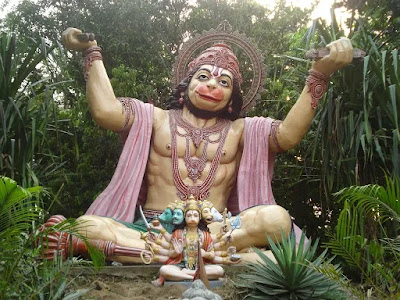
  Hanuman: pixabay Rama and Lakshmana journey southwards following Sita's trail by hearsay and hints. They reach the kingdom of Kiskinda, which was ruled by a monkey race that were extraordinarily intelligent and had godly parentage.  Hanuman, the companion and helper of Sugreeva who is the son of the sun god and chief of Kiskinda, sees Rama and studies him. Is he a warrior or an ascetic? Too curious to turn away, Hanuman confronts Rama and Lakshmana. They tell Hanuman who they are and why they were there. Hanuman believes them and turns from his scholarly form into his true monkey form. Hanuman then tells them of Sugreeva and his story. Sugreeva is the brother of Vali, who has immeasurable strength due to churning Mount Meru to create nectar for the gods. Everyone and all of nature was afraid of Vali due to this strength. One day, a demon named Mayavi challenged Vali and then retreated into the underworld. Vali followed him into the underworld and did not return immediately. ...

Reading Notes: The Ramayana Part B

Image
     Ravana killing Jatayu: Wikimedia Commons  Fearing that staying close to Ayodyha would inspire citizens to encourage him to return home, Rama and his group decided to move on. They set off towards Panchvati. During the journey, they met Jatayu, the Great Eagle. Jatayu was very close with Dasaratha and felt as a foster parent to Rama. He guided them to Panchvati. Once there, Lakshmana built them a hut; however, Rama still remembered his true reason for coming to Panchvati: to kill fiends and ultimately kill Ravana, the chief of the demons. To start his task, Rama set out to the woods where he met a beautiful woman. He discovers that this woman is in fact Ravana's sister. She claims that she rejects evil and wants to help Rama. She asks him to marry her. He immediately denies this claiming that he cannot marry her because she is not high enough class. She replies that because of her mother's class, she is able to wed anyone. Kamavalli, the woman, then sees Sita and...

Reading Notes: The Ramayana Part A

Image
                                                                                               Rama: Wikimedia Commons There was a king named Dasaratha who was sad because he did not have any children. He then finds a sage, Rishya Sringa, who performed a sacrificial fire that caused a supernatural being emerging with sacramental rice. When Dasaratha's wives ate this rice, they each had two children: Rama and Bharatha, and Lakshmana and Sathrugna. We find out later that Rama is the human incarnation of Vishnu, a supreme god. Later, Sage Viswamithra comes to see Dasaratha. He asks Dasaratha to allow him to take Rama to a sacred ground that is surrounded by evil. Distressed, Dasaratha initially says no, but th...

Reading Notes: The Crocodile in the River (Week 2 Reading Anthology)

Image
                                                                              A crocodile: Pixnio At this point in time this is an encounter between the Buddha-as-monkey and the crocodile. Devadatta is planning on trying to murder him; however, the Master claims this is not the first time and tells a story of the past about a previous failed murder attempt. Here is the story: Bodhisatta came to life as a monkey and was big and strong. He could jump large distances and would do so onto a large rock that allowed him passage to an island that was fruitful. He would go eat many fruits to his filling and then return home. A pair of crocodiles saw Bodhisatta and the female mate longed for his heart to eat. Wanting to fulfill h...

Week 2 Reading Overview

Image
                                                                  Page from a Dispersed Ramayana: Picryl After looking over the reading options for the Ramayana, I decided to go with the Narayan version. I chose this version mainly because I wanted to get the traditional story. I also already own the book, so why not use that version! However,  I do plan on utilizing other sources, such as the Tiny Tales, so that I can get multiple viewpoints on the stories.                Hanuman: MantraMaya I chose this comic story because I admired the title being about devotion and courage. When reading the overview of the story, I could see how devotion and courage were important to the plot. I also loved how the ...